AI Brand Case Studies
OpenAI's First Rebrand: When the Most Powerful Tech Company Finally Looked Like One
An analysis of OpenAI's 2025 rebrand by Veit Moeller and ABC Dinamo. How the imperfect O, custom typeface, and institutional design signal a company that has stopped thinking like a startup.
TL;DR
OpenAI spent nine months on a rebrand that introduced a deliberately imperfect O, a custom typeface, and institutional motion design. The company that builds superhuman text generation hired human typographers because branding is not content — it is meaning. And meaning remains a human specialty.
Here is a fact that should bother you a little. The company that built the most sophisticated text-generating system in history hired human typographers to design its wordmark. The company whose product can write entire novels in seconds spent nine months refining the curves of a single letter. And when someone asked whether ChatGPT had been used in the process, Head of Design Veit Moeller said yes, to calculate type weights. The creative decisions, the ones requiring taste and judgment and the accumulated intuition of people who have spent their careers learning to see, those stayed human.
There is something in this worth pausing over. Something about what it reveals about the limits of the technology and, maybe, about the nature of meaning itself. But first, the rebrand.
OpenAI spent years looking like an accident. Moeller and Design Director Shannon Jager, speaking from the company's San Francisco headquarters, admitted that the visual identity had been, as they put it, a jumble of fonts, marks, and colours without clear strategy or unity. Multiple typefaces served different products. Colors shifted depending on which team shipped last. The blossom logo, the hexagonal knot designed in 2017 by co-founders Greg Brockman and Ilya Sutskever, was elegant in its mathematics but carried a flaw that designers had noticed for years: asymmetrical line weights that made one petal appear slightly heavier than the others. The issue was subtle. In branding, subtle issues are still issues.
Sam Altman asked the design team to look at the identity about a year before the February 2025 launch. In that interval, the company's valuation climbed from $29 billion to $157 billion. ChatGPT reached 300 million weekly users. Sora launched. The gap between what OpenAI was and what OpenAI looked like had become a canyon.
The team that closed it was small and specific. Moeller, a former creative director at Mercedes-Benz Berlin who had shaped identities for Instagram and WhatsApp. Jager, whose typographic sensibility ran deep enough to call the resulting typeface "a love letter to typography" without it sounding like marketing. ABC Dinamo, the Berlin type foundry known for sharp, opinionated font design. Studio Dumbar in Rotterdam, a motion studio with decades of experience in European institutional design, the kind of firm that builds identities for governments and cultural organizations, not startups.
The partner selection tells you something. OpenAI did not hire a trendy studio. It hired institutions. People who understand that a brand is not a campaign but a system that must hold for years across contexts that cannot be predicted. The choice signals that OpenAI has stopped thinking of itself as a startup and started thinking of itself as infrastructure.
The blossom was redrawn with the lightest possible touch. Cleaner geometry. More uniform line thickness. A slightly larger central space that gives the mark breathing room without changing its essential character. Old and new side by side: you see the improvement. New on its own: you would never know anything had changed. This is the best outcome a logo refresh can achieve. It should feel like the mark finally arriving at the version it always should have been.
Now the letter.
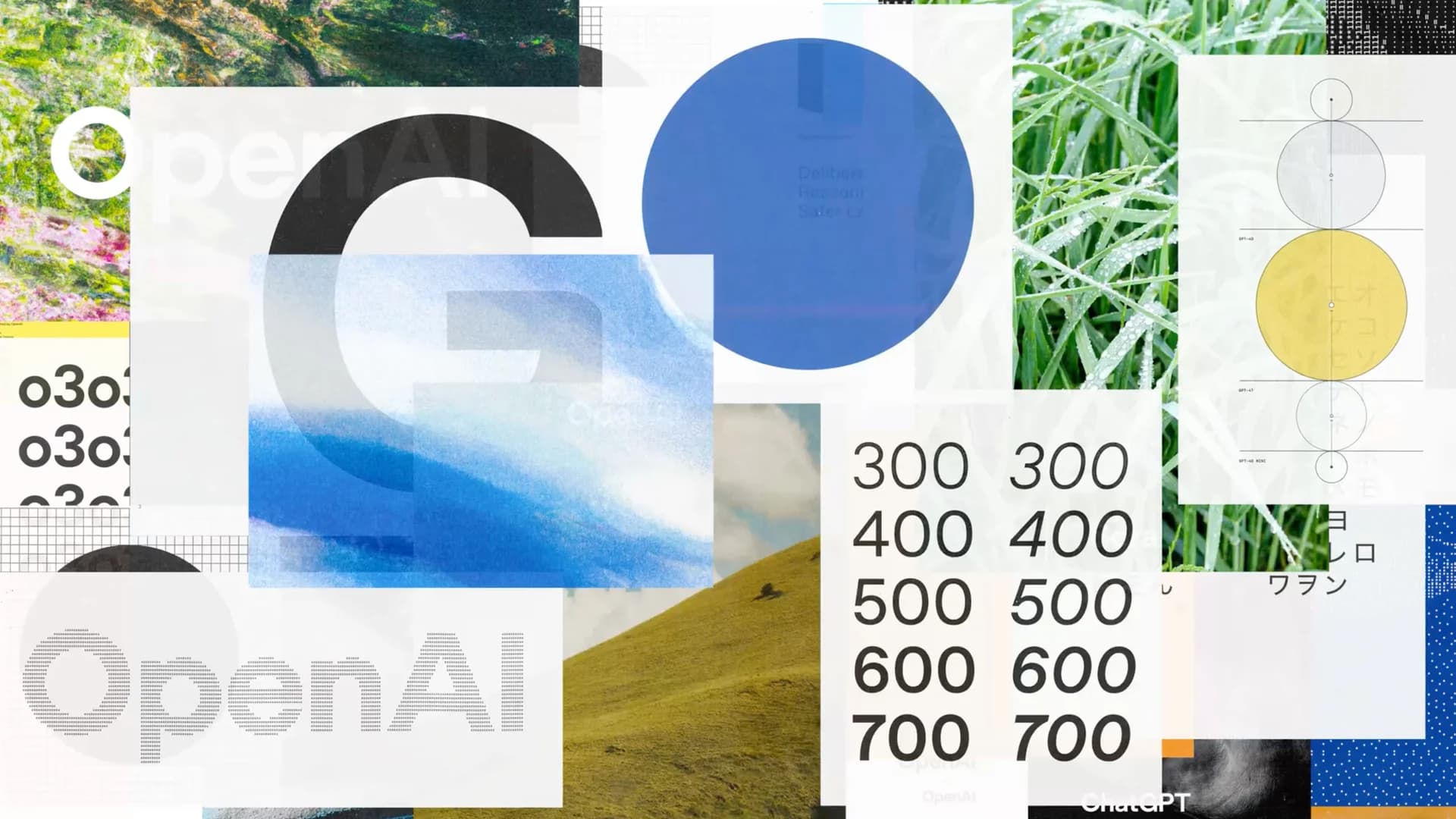
The capital O in OpenAI Sans is perfectly circular on the outside. Its interior form is not. Sit with that for a moment. A company that builds systems of extraordinary mathematical precision deliberately introduced asymmetry into the most prominent letter of its own name. Moeller described four core values for the new identity: simplify, space, imperfection, and vivid. The third one, imperfection, is the one that matters most, because it is the one no other technology company would have the nerve to articulate.
The imperfect O is a philosophical position disguised as a typographic detail. It says: we know what perfection looks like. We build it every day. And we believe that the human quality, the thing that distinguishes a person from a machine, lives precisely in the places where perfection breaks down. The wobble in a hand-drawn line. The catch in a voice. The asymmetry in a letter that would be trivially easy to make symmetrical. These imperfections are not flaws. They are signatures. They are how you know a human was here.
The circular dots above the lowercase i and j extend the idea into the smallest details of the type. They echo the pulsing cursor that ChatGPT displays while generating a response, that hypnotic loading indicator that has become one of the most widely recognized interface elements on earth. The typeface takes the product's signature moment, the waiting, the anticipation, the sense that something is being prepared for you, and builds it into the company's visual DNA. Every time you read the word "OpenAI" in its own typeface, you are seeing a reference to the experience of using its product.
Moeller described space as "underrated" and said the team wanted to "find the beauty in nothing." This is a more radical statement than it appears. Technology companies fill space. They cram screens with information, dashboards with metrics, homepages with features. The assertion that emptiness has beauty, that restraint communicates more than density, runs against the instincts of an industry that measures success in engagement and screen time. OpenAI's new identity has wide margins, generous line spacing, and a willingness to let visual elements breathe. It looks, in its quieter moments, more like a poetry publisher than a technology company.
The color palette shifted from monochrome austerity into a system of greys and blues that Moeller described as evoking horizons and expansive space. Warmer contrasting colors provide accent. Brand imagery now blends photography, landscape and still life, with patterns generated by Sora. This last detail is genuinely new. No major AI company has previously used its own generative models as a formal element of its brand identity. The circularity is interesting and a little vertiginous. The company builds the machine. The machine helps build the company's face. The company presents that face to the world. The world sees a face shaped, in part, by the machine.
Studio Dumbar contributed the motion dimension. The blossom now moves with more organic fluidity. A pulsating blue disc, the Emotive Point, represents ChatGPT's voice mode with what Moeller called a "watercolour-inspired" background of swirling abstract forms. The motion design has the quality of institutional choreography, measured, purposeful, unhurried, the visual equivalent of a company that has decided it will be around for a very long time.
The structural shift in the identity is easy to miss and important to understand. The blossom has been deprioritized. It now appears primarily in OpenAI Research contexts. The wordmark leads everywhere else. This follows the trajectory of every company that has grown from brand into institution. When Apple was small, the apple was everything. When Apple became Apple, the name was enough. When your name appears on 300 million screens weekly, the name is the symbol. The shift is OpenAI acknowledging, in the language of design, that it has crossed a threshold.
So return to the paradox that opened this essay. A company that generates language with superhuman fluency hired humans to design its letterforms. A company that creates images from text descriptions asked human designers to choose its colors. A company that could, in a narrow technical sense, produce a "brand identity" in hours spent nine months on one.
The reason is that branding is not content. A typeface is not a collection of shapes. It is an argument about what kind of organization you are and what kind of future you believe in. The imperfect O argues that humanity lives in imperfection. The generous spacing argues that emptiness has value. The institutional motion design argues that this company plans to endure. These are not outputs a machine can produce, because they are not information. They are meaning. And meaning, for now, remains a human specialty.
Whether OpenAI's actions will match the meaning its designers built is a question the typeface cannot answer. A brand is a promise. This one promises warmth, humanity, and intentional imperfection.
Promises, like letterforms, are tested by time.
More reading