AI Brand Case Studies
Mistral's Pixel M and Cohere's Voronoi Cells: The New Visual Grammar of AI
A comparative analysis of two AI brands that refused industry convention. How Mistral's hidden cat and Cohere's biological cell motif created distinctive identities in a sea of sameness.
TL;DR
Mistral and Cohere both rejected the stars-and-vortexes consensus of AI branding. Mistral's pixelated M hides a cat face referencing machine learning's origins, while Cohere's Voronoi cell system connects biology to computation. Both prove the visual grammar of AI is larger than most companies have allowed themselves to imagine.
Look at the logos of ten AI companies. Now look at them again. Stars. Apertures. Vortexes. Abstract geometric forms in cool blues and purples, each one gesturing toward intelligence and mystery without committing to any specific claim. The visual language of artificial intelligence calcified into cliche before the industry was five years old.
Sylvain Boyer noticed this. Boyer is a Paris-based designer who was, at the time, deep inside the Paris 2024 Olympic Games identity, shaping a design system that would need to be understood by billions of people across every language and culture on earth. When he spotted a job listing for a junior in-house designer at Mistral AI, the French open-source company that had raised a billion euros essentially on arrival, he applied. He got the job. And the first thing he did was study every AI brand he could find.
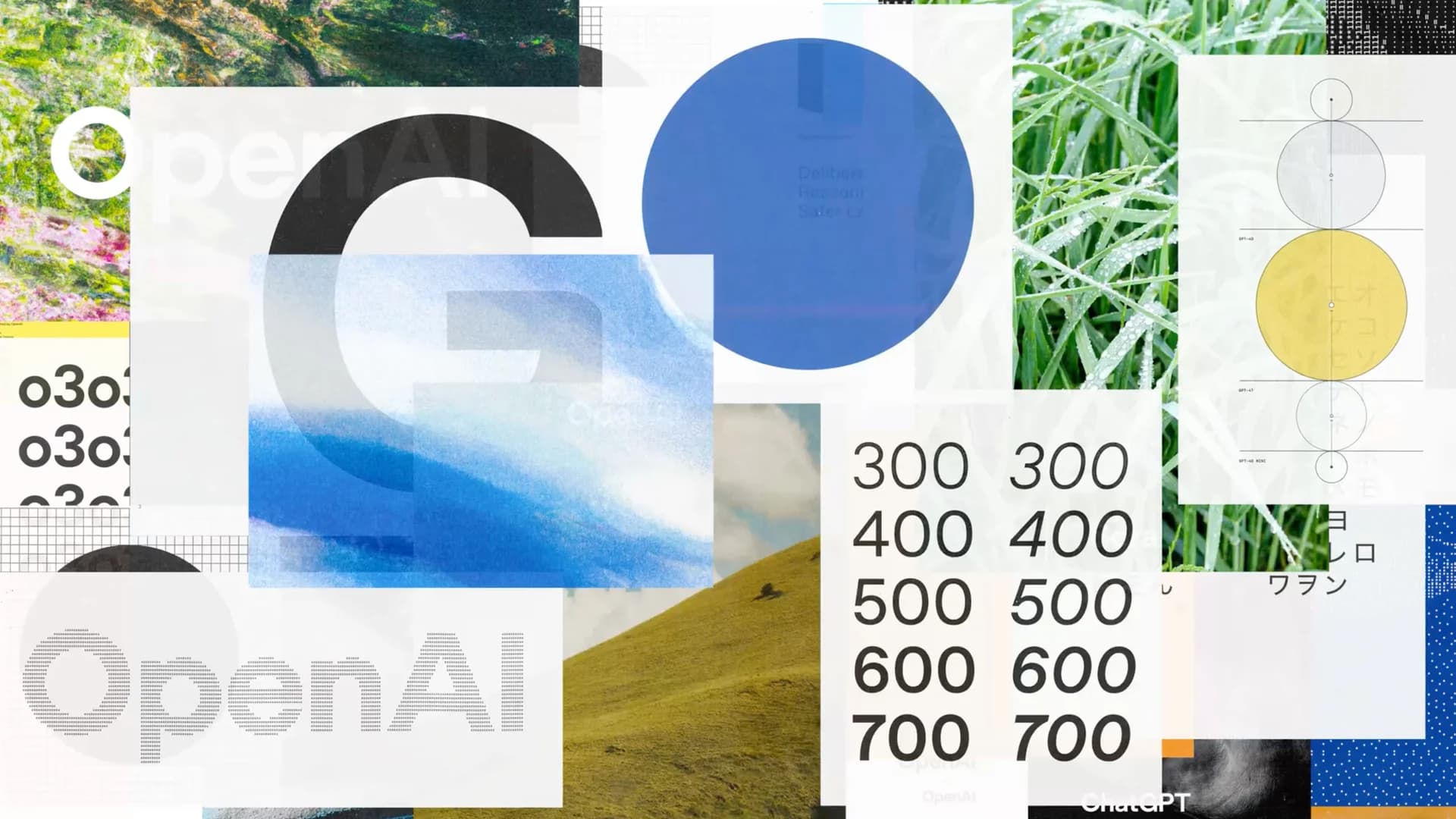
What he found was consensus. "There seems to be consensus in the AI branding codes," Boyer told Creative Review. Stars and magic. Gemini and Claude both have star symbols. Shopify has a magic wand. Wi-fi apps use undulating lines. The aperture-vortex family includes ChatGPT, OpenAI, DeepMind, Deep Motion. A handful of visual metaphors, repeated everywhere, saying the same thing: AI is mysterious and powerful.
Boyer went somewhere else entirely.
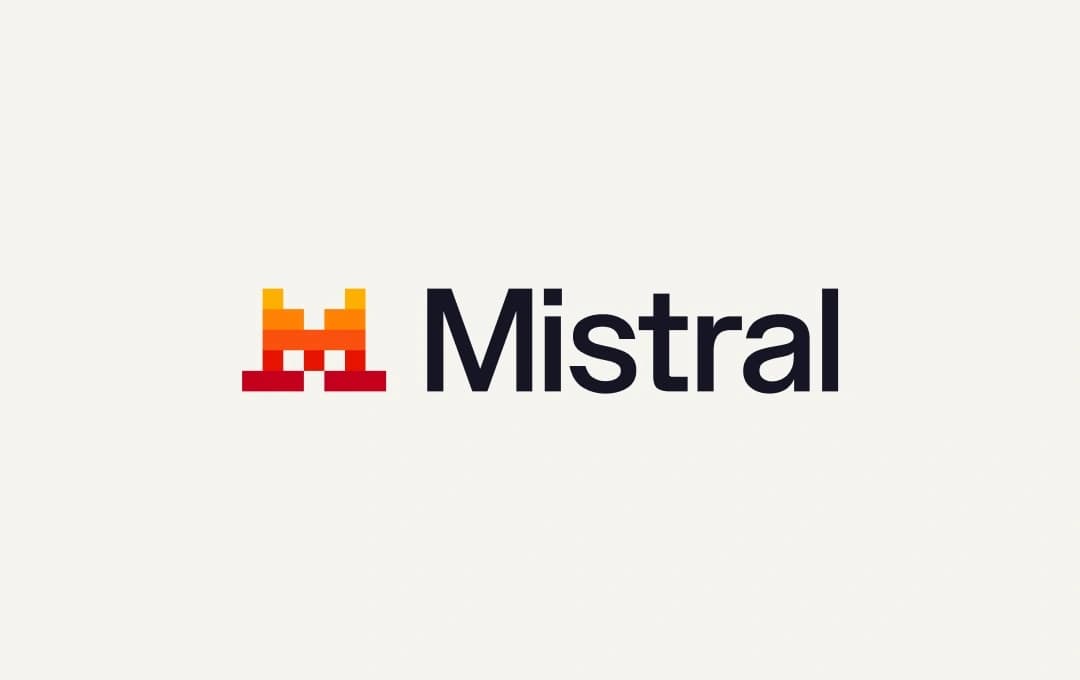
The Mistral mark is a pixelated letter M built from modular rectangular blocks, colored in a warm rainbow gradient that runs from red through orange to yellow. It looks like an indie game studio. It looks like something from the early days of personal computing, when pixels were visible and technology felt handmade. And hidden inside the geometry, visible only to those who are looking, is a cat's face.
The cat is partly a reference to Le Chat, Mistral's conversational assistant (le chat is French for "the cat"). But it carries a deeper reference that rewards anyone who knows the history of machine learning. In the early days of image recognition research, scientists trained their models on photographs of cats. Not because cats are important to artificial intelligence. Because cats were the most abundantly available image data on the internet. The first thing neural networks learned to see, before faces, before medical scans, before satellite imagery, was cats. Boyer embedded that origin story in the logo itself.
The hidden face demands a small effort of perception. You have to look for it. This is a very French quality. The Carrefour logo hides a C in the negative space between two red and blue arrows. The Tour de France conceals a cyclist in its typography. The FedEx arrow lives between the E and the x. Each of these marks creates a moment of recognition that transforms the viewer from passive to active. You see the cat once and you cannot unsee it, and that moment of discovery bonds you to the mark in a way that a more literal design never could.
The color palette refuses the industry's uniform. Where AI companies dress in cool blues and silver, Mistral runs hot. Reds, oranges, ambers. The warmth is not decorative. It signals approachability in a category that often feels intimidating. And it carries something harder to define but impossible to miss: a distinctly European confidence, a refusal to dress in Silicon Valley's clothes, a willingness to be unmistakably French in an industry that tends to flatten national identity into a single global tech aesthetic.
Within twenty-four hours of Le Chat's launch, the app became the most downloaded in Europe. President Macron publicly endorsed it over ChatGPT. Design alone does not explain adoption numbers. But the identity gave Mistral something most AI companies lack: a personality that made people want to try the product rather than merely evaluate it.
Now cross the Atlantic and go back about two years.
Cohere, founded in Toronto by Aidan Gomez, one of the eight co-authors of the original Transformer paper that made all of modern AI possible, needed a visual identity for a company that most of the world had never heard of. The challenge was to pull natural language processing out of the bleeding-edge experimental realm and into the world of ordinary business tools. Gomez and his co-founders approached Pentagram.
Jody Hudson-Powell and Luke Powell, partners in Pentagram's London office, spent nearly a year on the project. They began with a question that sounds abstract and produced an identity that is anything but: what would AI look like if we stopped treating it as science fiction and started treating it as nature?
The concept they arrived at was "new nature." The visual identity would introduce the fluidity and imperfections of the natural world to the rationality of computing. They turned to biology. Specifically, to cells. Specifically, to Voronoi diagrams.
A Voronoi diagram describes how space partitions around a set of points. It is a mathematical concept, named after the Ukrainian mathematician Georgy Voronoy, and it produces patterns that appear constantly in the natural world. The tessellated markings on a giraffe's hide. The cells of a dragonfly's wing. The structure of honeycomb. The cracked surface of dried mud. The patterns are, simultaneously, biological and mathematical, organic and precise. For a company trying to position language AI as a natural extension of human communication rather than a synthetic replacement for it, the metaphor was perfect.
The Cohere logo is a mark of three organic, irregular shapes forming an abstract C. The shapes look alive. They pulse. They feel as though they are about to divide, the way cells do. The cell motif carries into the custom typefaces with startling thoroughness. Cohere Text, a workhorse face in three weights, uses a faux-mono style that references the developer world. Cohere Outline, the headline typeface, features letterforms with Voronoi cell cuts that are automatically dispersed through the characters as you type. Each letter can be split at any point, introducing organic irregularity into the most controlled element of a design system. Typography normally demands consistency. Cohere's typography embraces variation, and the variation feels alive rather than chaotic because the cell logic governs every break.
What Pentagram delivered alongside the visual identity deserves attention because it reveals a mature understanding of how brands actually live in organizations. A Figma plugin that lets Cohere's in-house team generate Voronoi patterns without recreating them by hand. Layout component libraries for consistent but flexible communications. A custom Cinema 4D tool for creating three-dimensional cellular visuals. This is not a brand book that sits in a drawer after the agency leaves. It is a creative infrastructure, a set of capabilities that allows the identity to grow under new hands in directions that Pentagram could not have predicted. The best brand systems do not create dependence on their creators. They create independence.
Place these two identities side by side.
Mistral's power comes from cultural confidence. It is French. It is warm. It is playful. It references the democratic tradition of the pixel, the building block of digital imagery that every person who has used a screen intuitively understands. Boyer's Olympic background gave him an instinct for marks that must be understood by millions of people with no design training.
Cohere's power comes from scientific depth. It is biological. It is mathematical. It is layered. The cell motif carries from logo to typography to three-dimensional imagery to generative design tools, and at every scale it connects back to a single idea about the relationship between nature and computation. Where Mistral works through immediate charm, through the warmth of color and the delight of discovering the hidden cat, Cohere works through accumulated coherence, through the growing realization that every element of the system connects to every other element through a logic that mirrors the mathematics of the natural world.
Both companies refused the visual consensus of their industry. Both hired designers who started with ideas rather than aesthetics, who asked what the brand should mean before asking what it should look like. And both arrived at identities that communicate something specific, something only they could say, rather than something generic about being innovative.
The lesson, if there is one, is not to copy the pixels or the cells. It is to copy the courage. To study the consensus, understand why it exists, and then make a deliberate decision to go somewhere else. The visual grammar of AI is still being written. Mistral and Cohere proved that the alphabet is larger than most companies have allowed themselves to imagine.
Every industry gets the design language it deserves. The question is whether companies will accept the one they inherited or write their own.
More reading